
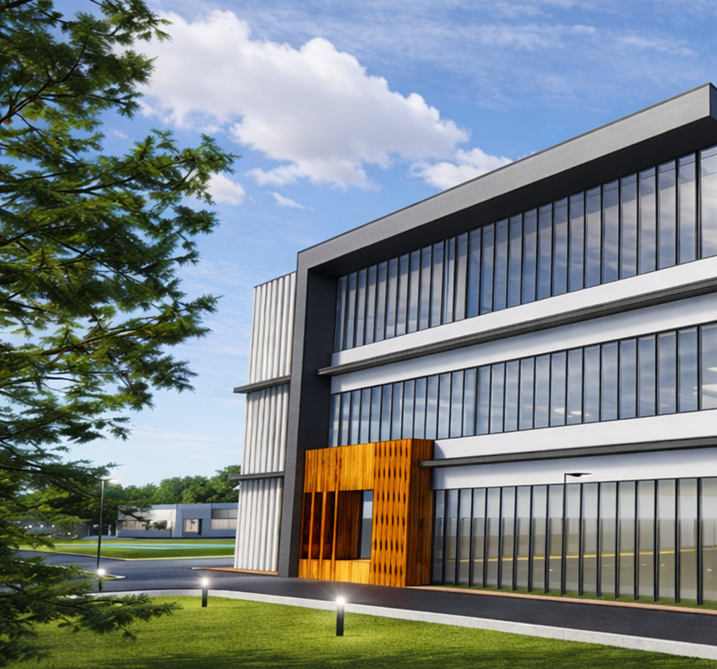
Hunterston Data Centre
Artist’s impression. Detailed visualisations are in preparation.
About the Project
Proposed Data Centre Campus at Hunterston
The proposed Hunterston Data Centre is in the early stages of development. Located in North Ayrshire, the project is being advanced by Eneus Energy and Revera Energy in partnership with the Hunterston Estate.
The data centre campus is being designed sustainably to support the growing demand for cloud services, artificial intelligence, and digital communications. By harnessing Scotland's plentiful supply of renewable energy, the project also supports the ambition of Ayrshire's local authorities to grow the region's digital economy and attract long-term investment.
The campus would create a modern, low-carbon data centre while delivering significant benefits in terms of employment and supply chain opportunities for the local area.
The Hunterston Data Centre project is being advanced through a comprehensive planning and environmental assessment process, including public consultation events, and we welcome feedback from residents, businesses, and stakeholders throughout its development.
The Hunterston Opportunity
Hunterston is uniquely positioned to support large-scale digital infrastructure due to its long-established role as an energy and industrial hub.
The site benefits from access to existing power, water, port, rail, and connectivity infrastructure, making it one of the few locations in the country capable of supporting a development of this scale while minimising the need for extensive new facilities and connections.
The proposed Hunterston Data Centre also represents one of the largest private investments in Ayrshire's history, with investment expected to exceed £10 billion. The project is expected to create more than 1,000 jobs during construction and 300-400 permanent jobs once operational, supporting North Ayrshire Council's ambition to attract investment, employment, and economic activity to the region.
The project is being designed to make efficient use of available resources and will harness Scotland's plentiful renewable energy resources through a high-voltage transmission connection. A closed-loop cooling approach is being incorporated into the project design to minimise water consumption and support responsible resource management. The cooling system will not require an ongoing water supply during normal operations and is not expected to adversely impact local water supplies.
As the project progresses, detailed environmental, transport, ecology, landscape, and planning assessments will continue to inform the development and help ensure the project is advanced in a responsible and sustainable manner.
Proposed Data Centre Campus
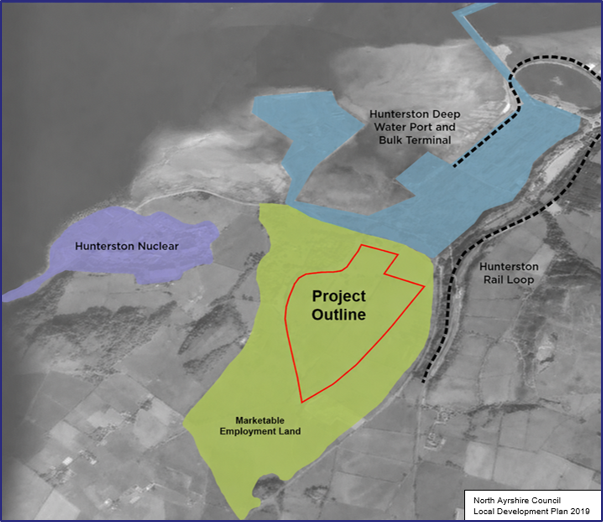
Project Overview
Location
Hunterston, North Ayrshire
Site Size
Approximately 164 acres
Project Partnership
Eneus Energy and Hunterston Estate
Community Engagement
Ongoing consultation and stakeholder engagement
Cooling System
Closed-loop cooling approach
Water Supply
Confirmed water supply for site operations
Energy Infrastructure
Existing power network connections
Connectivity
Access to regional fibre networks
Community Consultation
We are committed to engaging openly and transparently with local residents, businesses, community organisations, and public authorities throughout the development process.
Community consultation provides an opportunity to learn more about the project, ask questions, and provide feedback that can help inform the project’s development.
Information on consultation events, project updates, and opportunities to provide comments will be published here as the project progresses.
Landscape Integration
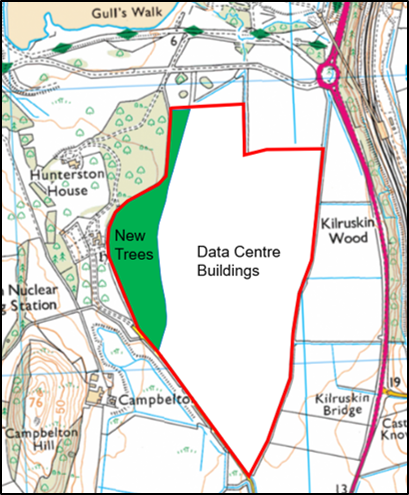
The proposed campus incorporates landscape screening and new tree planting designed to help integrate the site with its surroundings.
These measures are intended to soften views of the site from nearby areas and create a well-designed transition between the campus and the surrounding landscape. The proposed trees and shrubs will effectively extend the existing Estate woodlands, helping to screen views of the development while also providing biodiversity enhancement benefits.
Frequently Asked Questions
Community & Environment
-
A: Eneus is working closely with Hunterston Estate and local partners to ensure that the construction and operation of the Hunterston Data Centre Project integrate smoothly into the community, with any impacts minimised. A Construction Management Plan will be put in place, taking account of community interests, as determined at the consultation stage and through ongoing dialogue. Construction will occur in phases to minimise disruption, and traffic management plans are being developed with local agencies. Once operating, the facility will generate steady economic activity with limited daily traffic or noise.
-
A: The project will be designed to limit impacts as far as practicable. Construction activity will be carefully scheduled to minimise any congestion impacts and to maintain existing access provisions for local residents and the general public.
The design of the data centre ensures that any noise emissions are reduced through the use of advanced cooling technology, including variable speed drives, acoustic shielding, and other measures.
-
A: The buildings are being designed in a manner which respects the local landscape and views from public locations. Landscaping and screening works (including establishing new trees and shrubs) will minimise the visual impact of the project where possible, and indicative views from agreed viewpoints will be presented at the public consultation stage for community review.
Most importantly, in agreement with Hunterston Estate, a buffer zone has been established between the Castle and the nearest data centre buildings, which will be set back a considerable distance and kept to the east of the old haul road. The area in between will be planted with native tree and shrub species, in effect extending the existing policy woodlands around the Estate. The new plantings will serve dual purposes of landscaping and screening, while also providing biodiversity enhancement benefits.
-
A: No. A suitable water supply has been confirmed by Scottish Water (served by their Camphill Water Treatment Works), which more than meets the water needs of staff and typical light industrial processes on the site, including cleaning.
Importantly, this project will use a modern closed-loop cooling system which itself requires no ongoing water supply. The only notable water requirement is for the initial filling of the cooling system, which is anticipated to be trucked in during commissioning.
-
A: No. The data centre connects directly at the high-voltage transmission level, separate from residential and small business systems. Rather than increasing costs, the project will reduce them by using renewable power at times of system excess (i.e., strong wind conditions coinciding with low system demand in Scotland). Under these conditions, at present, significant quantities of power are wasted when wind farms have to be shut off. The data centre project will make use of such power, allowing wind farms to continue to operate efficiently and to capture all available wind energy. This results in a better-balanced grid and significantly reduced system costs (recently acknowledged by the UK grid operator, NESO).
-
A: Eneus has completed a flood risk assessment which indicates that there is no risk of coastal flooding (due to the site being, on average, 24 feet above sea level) and that any potential local flooding due to high rainfall events can be dealt with by ensuring that the ground floor levels are slightly raised to meet a 1-in-1,000-year worst-case flood scenario.
The design of the project will meet the exacting standards set by the Scottish Environment Protection Agency (SEPA), which include making allowance for the effects of climate change.
-
A: Hunterston Estate has always maintained an open-door policy for walkers and recognises the Outdoor Access Code. Public access to the wider Estate will continue, subject to any temporary restrictions that may be required during construction for safety reasons.
As with any industrial facility, the data centre campus itself will be a secure, managed site with controlled access. These security measures will apply only within the operational area of the development and are not intended to affect public access to the wider Estate.
-
A: The combination of commitment to using renewable power, along with use of energy, which is otherwise curtailed, will result in a very low carbon footprint for this data centre facility, likely one of the lowest-carbon-footprint data centres anywhere in the world.
Jobs & Economy
-
A: The Hunterston Data Centre Project represents one of the largest private investments in Ayrshire’s history (in excess of £10 billion), and a significant proportion will fall to Ayrshire and Scottish supply chain companies. The project supports both construction and long-term operations jobs and is expected to attract new businesses to the area.
-
A: Yes. Eneus will work with local contractors, suppliers, and professional service firms. The project's scale and construction over several years will create varied opportunities for regional participation across construction, logistics, and operations. The Hunterston area is already served by a well-developed supply chain, given the long history of activity at the port, the nuclear power station, and more widely in Ayrshire. A supply chain engagement plan is being prepared, with input from North Ayrshire Council, to ensure that these opportunities are maximised.
In addition, a Skills, Employment and Training Plan is being prepared, which will guide measures to ensure availability of labour and suitably qualified contractors. We will be expected to maximise this in support of local authority and Scottish Government social and employment objectives.
-
A: During construction, the project is expected to support in excess of 1,000 jobs, including skilled trades, equipment operators, and technical specialists.
Once operational, the data centre is expected to employ an appreciable number* of full-time on-site staff in a variety of roles, including highly skilled positions in IT-related disciplines. Other roles are expected to include technicians, maintenance personnel, and facility management staff, with additional indirect employment supported through local suppliers and service businesses.
Eneus is developing a programme of measures, including apprenticeships, to help local people enter the digital sector. This will include opportunities for those currently in education, as well as individuals seeking to transfer skills from other industries. The programme will be developed in partnership with enterprise agencies and educational institutions.
*Operational job numbers are currently under review and will be published, together with supporting evidence, as the project progresses.
-
A: The data centre will provide a vital, long-term income stream to safeguard the future of Hunterston. It will allow the Estate to invest in property and related infrastructure, which are dated, in a poor state of repair, and require modernisation. These works will help the Estate and local community to thrive and enjoy all Hunterston can offer, sustaining the area for generations to come.
Investment is crucial to safeguarding the future of Hunterston Castle, the historic seat of Clan Hunter. It would also facilitate improvements to Hunterston House, a sought-after venue for period dramas in television and in film. These enhancements are vital to secure its future as the home of the Kennedy Cochrane Patrick family and Clan Hunter, and to capitalise on future TV and film production opportunities, which generate substantial interest and revenue for the region. Hunterston House has previously served as a backdrop for notable productions such as Outlander, Jonathan Creek, and film adaptations of Sherlock Holmes and The 39 Steps.
About Data Centres
-
A: A data centre is a "warehouse for information" – a facility that processes and stores data and digital information. It houses computing machines and related hardware equipment, such as servers, data storage drives, and network equipment.
Data centres are the essential infrastructure powering the digital economy, serving cloud providers like Amazon and Microsoft, and tech companies including Google, Meta (which owns Facebook, WhatsApp, and Instagram), and Netflix. Data centres are also used by more traditional businesses across all industries for their databases and online operations, by government agencies delivering public services, and by the everyday internet services we all rely on—from email and social media to online banking and streaming. With the growth of artificial intelligence, autonomous vehicles, and smart city technologies, demand for data centre capacity continues to grow, making facilities like this critical to supporting both current digital services and future technological growth.
-
A: Our world is moving increasingly into the digital domain, which is creating significantly increased demand for data storage and processing. Perhaps the greatest driver of this increased demand is Artificial Intelligence (AI), which in general terms is the development of computer systems capable of performing tasks which typically require human intelligence. Example tasks are learning, problem-solving, decision-making, visual perception, speech recognition, and language translation, often using machine learning algorithms to learn from data.
The range of applications for AI is continually growing, but areas which are already active and which are showing the most promise for future benefits include:
• Health care improvements (e.g., diagnosis)
• Scientific developments
• Engineering innovation
• Manufacturing productivity improvements
• Public service improvements
• Data storage and processing
• National security
• Economic growthThese applications are expected to provide multiple benefits for mankind, which translate to increased economic growth and enhanced quality of life. This is recognised in UK Government policy through its AI Growth Plan, and in support measures being implemented by the Scottish Government. There is a stated Government objective to grow computing capacity in the UK twenty-fold by 2030, and this means significantly expanding our data centre capacity around the country.
-
A: The data centre will operate on power supplied from the grid throughout the year and, given the robustness of the high-voltage grid at Hunterston, can be expected to have a supply which is almost entirely free of interruption. On the rare occasion when a grid fault does occur, it is important, as with any industrial facility, that an emergency backup power supply can kick in. The project will therefore include battery backup supplies to cover short-term interruptions (up to ten minutes). In the event of a longer-term interruption (extremely unusual), onsite emergency generators will kick in to ensure the safe run-down of plant and apparatus. These generators can run for up to 48 hours and will operate on clean fuel such as biodiesel.
-
A: The Hunterston Data Centre Project is fully backed by The Carlyle Group and GIC, two of the world's most respected infrastructure investors. Their financial strength ensures the project's success and long-term stability in the community.
Planning & Consultation
-
The current programme is for a planning application to be submitted in 2026. Subject to planning approval and other necessary consents, construction is anticipated to begin in 2027/28. Timescales may change as the project progresses through the planning and environmental assessment process.
-
Yes. We have committed to completing a full Environmental Impact Assessment (EIA) to accompany our planning application. This work is already underway and will assess a wide range of environmental topics, including transport, ecology, landscape and visual effects, noise, water, and cultural heritage. The EIA process helps ensure that potential impacts are identified, assessed, and addressed through the design and planning of the project.
-
We are committed to engaging openly with local residents, businesses, community organisations, and public authorities throughout the development process. Project updates, consultation events, and opportunities to provide feedback will be shared through this website and through public consultation activities as the project progresses.
Contact Us
We welcome questions, comments and feedback from residents, businesses, community organisations, and other stakeholders interested in the Hunterston Data Centre project.
As the project progresses, we are committed to providing clear information and maintaining an open dialogue with the local community. If you would like to learn more about the project, provide feedback, or discuss potential opportunities, please get in touch using the form below.